Interactive Voice Response systems are no longer just about pushing buttons and wading through rigid phone menus. With the rise of artificial intelligence, an AI IVR system can understand natural speech, personalize every interaction, and intelligently route customers in seconds. Beyond improving call handling, it plays a crucial role in enhancing support operations and shaping AI strategies for growing support teams, helping businesses scale efficiently while keeping customers satisfied.
This guide explains what AI IVR is, how it works, the benefits you can expect, and what to look for when choosing and deploying a solution.
Modern AI IVR systems are powered by advanced algorithms that can interpret customer intent, reduce wait times, and even predict common issues before they occur. Companies exploring innovative cloud computing platforms for large-scale automation are discovering how these systems integrate seamlessly into existing workflows. By leveraging real-time analytics and intelligent routing, businesses can provide a more responsive and personalized customer experience.
For teams aiming to maximize efficiency, supercomputing solutions for data-heavy operations can support high-volume call centers, ensuring that the AI IVR system remains fast and reliable even during peak traffic. This allows support staff to focus on more complex interactions while routine requests are handled automatically.
Marketing teams also benefit when AI-driven IVR solutions are used strategically. Sites like Marketing for Customers’ insights on engagement-driven tools highlight how AI can guide customer journeys, improving satisfaction while increasing operational efficiency. Long-tail strategies, such as how AI-powered customer interaction analytics boost team performance, provide actionable steps for managers looking to implement smarter call-handling processes.
Financial institutions see particular value, as the system can integrate with top financial resources for better risk management and customer support, ensuring sensitive transactions are routed securely and efficiently. By combining robust AI with scalable infrastructure, businesses across industries can maintain high service standards without overburdening staff.
In short, an AI IVR system is no longer just a convenience—it’s a central part of modern customer experience strategies, helping companies respond quickly, operate efficiently, and stay ahead in a competitive emviornment.
Top 10 AI Contact Center Solutions for Modern Businesses
AI-driven contact centers are transforming how companies handle customer interactions. An AI IVR system enables natural conversations, faster routing, and smarter decision-making, making it easier for businesses to provide seamless customer support. Here’s a list of the top 10 solutions to consider:
1. Bright Pattern – Comprehensive AI Contact Center Solutions
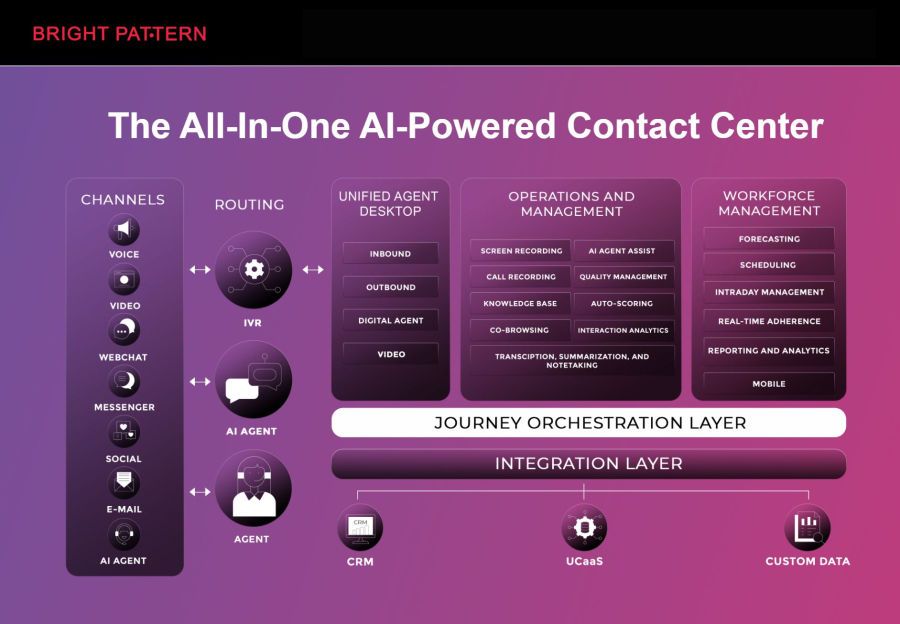
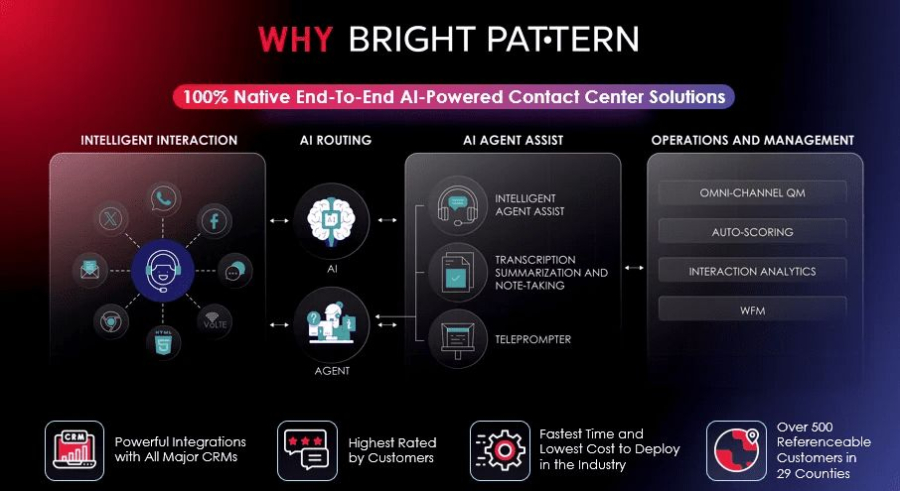
Bright Pattern is a leader in AI-driven contact center technology, offering a robust AI IVR system that streamlines communication and improves customer satisfaction. Its platform connects multiple channels, enabling voice, chat, and messaging interactions through a single interface. Key benefits include:
- Intelligent call routing to the right agent based on skills and context
- Real-time analytics and performance dashboards for monitoring team efficiency
- Omnichannel support across voice, SMS, email, social media, and web chat
- Easy integration with CRM systems and enterprise applications
- AI-powered conversation insights to improve agent training and customer experience
Bright Pattern’s solution is ideal for businesses seeking a fully scalable AI IVR system that enhances call center productivity while maintaining personalized customer engagement.
2. Five9 – Cloud Contact Center Platform
Five9 provides an AI-driven cloud contact center platform with predictive dialers, IVR automation, and advanced analytics. Its AI capabilities help reduce wait times and improve first-contact resolution.
3. Genesys Cloud CX – Omnichannel Contact Center
Genesys Cloud CX offers an integrated AI IVR system that supports voice, messaging, and digital channels. It includes AI chatbots, real-time analytics, and workforce optimization tools.
4. NICE inContact – Intelligent Customer Engagement
NICE inContact CXone delivers AI-powered IVR, omnichannel routing, and robust reporting tools, helping businesses enhance efficiency and customer satisfaction.
5. Talkdesk – AI-Enhanced Call Center Platform
Talkdesk combines AI automation, intelligent routing, and real-time reporting. Its platform enables rapid deployment of AI IVR systems for enterprises of any size.
6. 8x8 Contact Center – Unified AI Communications
8x8 provides an AI IVR system integrated with voice, chat, and video. Its platform includes speech analytics and automated workflows for a more responsive contact center.
7. Cisco Contact Center – Enterprise AI Solutions
Cisco’s AI-driven contact center solutions focus on omnichannel engagement, AI-assisted routing, and analytics to optimize call handling and support efficiency.
8. Avaya OneCloud – AI-Powered Customer Service
Avaya OneCloud uses AI to enhance IVR systems, offering predictive routing, self-service automation, and integration with enterprise communication tools.
9. RingCentral Contact Center – Smart AI Call Management
RingCentral delivers a cloud-based AI IVR system with omnichannel support, real-time dashboards, and advanced workforce management for better service delivery.
10. Mitel MiCloud Connect – Flexible AI Call Center Solutions
Mitel provides a cloud contact center with AI IVR automation, analytics, and omnichannel capabilities, designed for scalable business communication.
What Is an AI IVR System?
AnAI IVR(Artificial Intelligence Interactive Voice Response) system is a phone self service solution that uses technologies like speech recognition, natural language understanding, and machine learning to handle calls in a more human, conversational way.
Instead of saying, "Press 1 for billing, press 2 for support, press 3 for sales," an AI IVR might say, "How can I help you today?" and then understand a response like, "I want to change my payment method" or "I need to reset my password."
From there, it can either solve the issue directly or route the caller to the right agent or department with all relevant context attached.
How AI IVR Differs from Traditional IVR
Traditional IVR systems are rule based. They follow fixed decision trees designed by humans, and callers must navigate menus using keypad input or limited voice commands.
An AI IVR system, by contrast, isconversation first. It can interpret open ended requests, learn from previous interactions, and continuously improve. Below are some core differences.
|
Aspect |
Traditional IVR |
AI IVR System |
|
Interaction style |
Menu based, press or say numbers |
Natural language, ask and answer in plain speech |
|
Flexibility |
Rigid, requires manual reprogramming |
Adaptive, can be updated and optimized continuously |
|
Personalization |
Limited, often one size fits all |
High, can use customer data and context |
|
Routing accuracy |
Based on menu choices only |
Based on intent, sentiment, and history |
|
Customer effort |
High, multiple steps and long menus |
Lower, direct intent capture and faster resolutions |
|
Continuous improvement |
Manual tuning by IVR administrators |
Machine learning driven optimization |
Key Benefits of an AI IVR System
Organizations adopt AI IVR solutions to drive concrete business outcomes. Below are the most impactful benefits you can expect when you implement and optimize an AI powered IVR.
1. Faster Resolution and Lower Wait Times
AI IVR systems can handle large volumes of routine calls instantly, without requiring callers to wait for the next available agent.
- Immediate responsesto common questions such as balance inquiries, order status, and password resets.
- Smart routingsends complex issues directly to the right specialist, reducing transfers and re explaining the issue.
- 24 / 7 availabilityensures customers can get answers even outside business hours, without long queues.
2. Improved Customer Experience
Customers often dislike traditional IVR menus because they feel slow, confusing, and impersonal. AI powered IVR can dramatically change that experience.
- Natural, conversational prompts instead of complex nested menus.
- Ability to skip menus altogether and simply say what they need.
- Personalized greetings and responses based on who is calling and why.
- Fewer repetitive questions because caller data and previous interactions are recognized.
The result is a smoother, more intuitive experience that aligns with how people naturally talk.
3. Higher First Contact Resolution
Because AI IVR can understand intent, validate identity, and connect to back end systems, it can resolve many requests end to end without agent involvement. When escalation is needed, the agent receives context such as:
- Transcription of what the caller said in the IVR.
- Customer profile and previous interactions.
- Likely intent and suggested next actions.
This prepares agents to solve issues quickly, increasing first contact resolution rates and reducing handle times.
4. Lower Operational Costs
By automating high volume, low complexity interactions, AI IVR systems allow your agents to focus on higher value conversations. Over time this can help you:
- Handle more calls without proportionally increasing headcount.
- Reduce overtime and reliance on temporary staff during peak seasons.
- Control outsourcing or overflow costs by keeping more interactions in automated channels.
These efficiencies compound as the AI IVR learns from new scenarios and expands its automation coverage.
5. Better Insights from Voice Data
Voice interactions are a rich source of customer insight. AI IVR systems can automatically analyze this data, revealing patterns that were previously hidden. For example, you can discover:
- Common reasons customers contact your business.
- Recurring friction points in your products or processes.
- Emerging issues or spikes in specific topic areas.
These insights support better decision making in product management, marketing, and customer success.
6. Consistent, Compliant Service
AI IVR systems deliver consistent messaging and can help enforce compliance guidelines. Once you define what should be said and how, the system repeats it accurately every time.
- Standardized disclosures for regulated industries.
- Approved scripting for sensitive topics such as payments or healthcare information.
- Automatic logging of interactions for auditing and quality review.
Core Capabilities of a Modern AI IVR System
Not all AI IVR solutions are equal. When evaluating platforms, look for capabilities that directly support better customer outcomes and operational efficiency.
Natural Language Understanding (NLU)
NLU is the engine that allows your IVR to comprehend what callers say, even when they use different words or phrasing to describe the same problem. Strong NLU can:
- Recognize intents such as "update my address" or "track delivery" from free form speech.
- Handle synonyms and varied sentence structures.
- Extract key details like names, dates, and account identifiers.
Automatic Speech Recognition (ASR)
ASR converts spoken words into text that the AI can process. High quality ASR is essential for accuracy, especially in noisy environments or with diverse accents. Modern AI IVR systems use advanced, often cloud based, ASR models to improve recognition rates over time.
Dialog Management
Dialog management governs how the conversation flows. A strong dialog manager helps the IVR:
- Ask clarifying questions when needed, without sounding repetitive.
- Handle interruptions and changes in topic gracefully.
- Guide callers to the next best step based on intent and context.
Integration with Back End Systems
To deliver real value, an AI IVR must connect to your existing technology stack, such as:
- CRM platforms and customer databases.
- Order management, billing, and ticketing systems.
- Authentication and identity management services.
These integrations allow the system to update records, check statuses, and perform self service actions on behalf of the caller.
Omnichannel Consistency
Many AI IVR platforms share components with chatbots and digital assistants. This enables a consistent experience across channels, for example using the same intents and knowledge base for voice, chat, and messaging.
Analytics and Optimization Tools
Look for built in analytics that measure outcomes such as:
- Containment rate (calls resolved within the IVR).
- Transfer and escalation rates.
- Average handle time and queue times.
- Customer satisfaction metrics such as post call surveys.
Optimization tools let you iterate quickly, adjust prompts, add new intents, and test improvements without extensive coding.
High Impact Use Cases for AI IVR
AI IVR shines brightest when applied to frequent, well defined tasks where speed and accuracy matter. Below are common use cases across industries.
Banking and Financial Services
- Balance inquiries and recent transaction history.
- Card activation, card freeze, or card replacement requests.
- Loan payment reminders and payment processing.
- Secure identity verification using multi factor prompts.
Retail and E Commerce
- Order status, shipping updates, and delivery changes.
- Returns, exchanges, and refund status.
- Store hours, locations, and product availability.
Telecommunications and Utilities
- Bill explanations and payment arrangements.
- Service outage information and restoration updates.
- Plan changes, upgrades, and add on services.
Healthcare and Insurance
- Appointment confirmations, reminders, and rescheduling.
- Benefits explanations and coverage questions.
- Claim status updates and documentation requirements.
How AI IVR Improves Key Metrics
When implemented with clear goals, AI IVR systems can positively affect multiple contact center and customer experience metrics.
|
Metric |
Traditional IVR Impact |
AI IVR Impact |
|
Customer satisfaction |
Often neutral or negative due to rigid menus |
Improved through natural conversations and shorter effort |
|
Average handle time |
May decrease slightly, but limited by menu depth |
Reduced as AI handles routine tasks and pre qualifies calls |
|
First contact resolution |
Improved primarily via basic routing |
Enhanced by intent recognition and rich context for agents |
|
Agent utilization |
Agents spend time on simple repetitive tasks |
Agents focus on high value, complex interactions |
|
Operational cost per call |
Can be high when live assistance is needed for basics |
Lower as automation handles a greater share of volume |
Steps to Implement an AI IVR System
Deploying AI IVR is most successful when approached as a focused, iterative project rather than a one time technology purchase. Here is a practical roadmap.
1. Define Clear Objectives and Success Metrics
Clarify why you are adopting AI IVR and how you will measure success. Possible objectives include:
- Reducing average speed of answer and queue times.
- Increasing self service rates for specific tasks.
- Improving customer satisfaction scores for phone support.
- Lowering overall contact center costs.
Turn these into measurable targets so you can track progress.
2. Identify High Volume, High Impact Call Types
Analyze call logs and agent notes to find the most frequent reasons for contact. Start with interactions that:
- Have clear, repeatable processes.
- Do not require complex judgment or exceptions.
- Are currently consuming significant agent time.
These are strong candidates for initial AI IVR automation.
3. Map Customer Journeys and Dialog Flows
For each selected use case, design a simple, conversational flow. Focus on:
- How the system will greet and identify the caller.
- Key questions needed to understand the intent.
- What information must be collected to complete the task.
- Clear paths to escalate to a human when needed.
4. Integrate with Your Existing Systems
Connect the AI IVR to the back end systems required to fulfill each use case, such as checking orders, processing payments, or updating customer details. Decide which data can be used to personalize the experience safely and in line with privacy requirements.
5. Pilot, Measure, and Iterate
Launch a pilot with a subset of traffic or specific lines of business. Monitor:
- Call completion and containment rates.
- Customer feedback and any reported friction.
- Agent feedback on the quality of context they receive.
Use these insights to refine prompts, add new intents, and adjust routing. Expansion should be incremental and data driven.
6. Train and Support Your Agents
AI IVR does not replace agents; it elevates their role. Ensure agents understand:
- How calls are being routed to them by the AI IVR.
- What context and recommendations they will see on their screens.
- How they can flag new scenarios for automation.
This turns agents into active partners in improving the system rather than passive recipients of a technology change.
Best Practices for a High Performing AI IVR
Well designed AI IVR systems keep customers engaged and deliver strong business outcomes. Consider these best practices as you build and optimize your solution.
Use Simple, Human Language
Avoid overly formal or technical wording. Short, clear prompts help callers understand what they can do and how to respond. Test scripts with real users and revise based on their feedback.
Always Offer a Path to a Human Agent
Even the most advanced AI IVR will encounter scenarios it cannot handle confidently. Make it easy for callers to say things like "talk to a person" or "agent" and be transferred. This protects customer satisfaction while the system keeps learning.
Set Expectations Up Front
Let callers know what the system can help with. For example, the greeting can mention a few key capabilities, such as checking orders or updating account details. Clear expectations reduce confusion and increase self service adoption.
Respect Privacy and Compliance
Be transparent about how caller data is used. Ensure that identity verification, data retrieval, and call recording comply with relevant regulations and your own privacy policies. Carefully design authentication flows to balance security with convenience.
Continuously Monitor and Improve
AI IVR is not a set and forget tool. Review analytics regularly to:
- Spot intents the system fails to recognize.
- Identify prompts that lead to confusion or abandonment.
- Expand automation to new call types based on demand.
This ongoing optimization is where organizations unlock the highest returns.
AI IVR in an Omnichannel Strategy
Modern customers move fluidly between channels voice, chat, email, messaging, and more. AI IVR should be part of a unified, omnichannel experience rather than a standalone tool.
- Shared knowledge baseacross bots and IVR ensures consistent answers.
- Cross channel contextmeans an interaction started in chat can continue over the phone without repeating information.
- Unified analyticsgive a complete picture of customer behavior across digital and voice touchpoints.
When integrated in this way, AI IVR becomes a cornerstone of a cohesive customer engagement strategy.
The Future of AI IVR Systems
AI IVR technology is evolving quickly. Looking ahead, organizations can expect improvements such as:
- Even more accurate speech recognition across languages and accents.
- Deeper personalization using real time intent, sentiment, and customer history.
- Tighter integration with generative AI tools to handle complex, multi step requests by orchestrating multiple systems in the background.
- Proactive outreach, where AI initiates helpful calls or messages about important events or deadlines.
These advancements will continue to shift routine work away from agents and free them to focus on empathy, problem solving, and relationship building.
Conclusion: Turning AI IVR Into a Competitive Advantage
An AI IVR system is far more than a modernized phone menu. When thoughtfully implemented, it becomes a strategic asset that:
- Delights customers with fast, natural, and personalized service.
- Reduces strain on your contact center and lowers operating costs.
- Generates valuable insights from every conversation.
- Supports a consistent, high quality experience across all channels.
By starting with clear goals, focusing on high impact use cases, and committing to continuous improvement, you can turn AI IVR from a buzzword into a measurable advantage for your organization and your customers.
